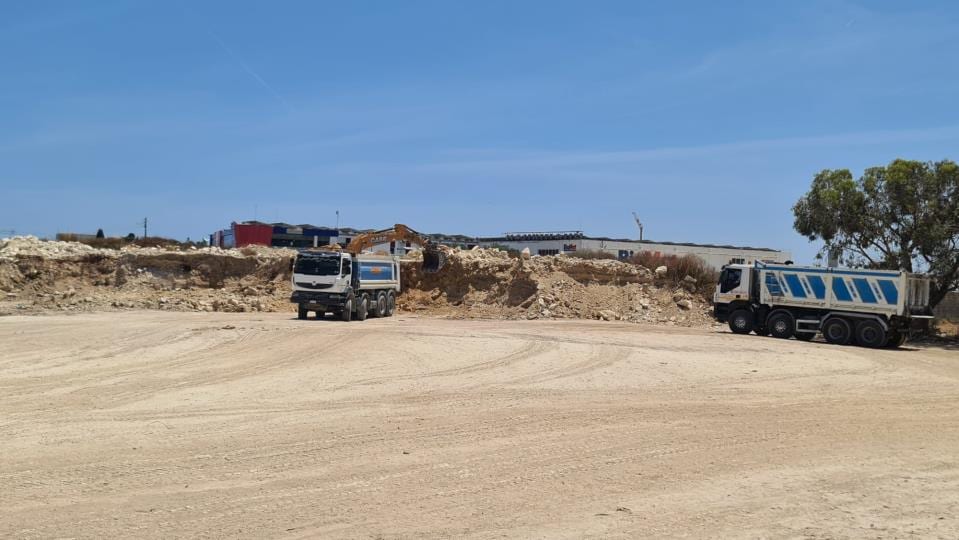
Ta' Qali's beloved 13,000m² rubble masterpiece retires undefeated, survivor of 100,000 euro in fines
The ground at Ta' Qali shrugged off more than 800 tons of Luftwaffe bombs. A 13,000 square metre rubble installation, after a decade of enforcement, is undone instead by a clipboard.
Heritage admirers, brace yourselves. After almost a decade on continuous display, the most committed rubble installation at Ta’ Qali is being struck from the landscape, and it goes out the way every great work should: undefeated, unrepentant, and several truckloads heavier than when it arrived.
Consider the provenance of the ground beneath it. Ta’ Qali was a Royal Air Force fighter airfield, laid out across a dried lake bed, that flew Hurricanes and Spitfires through the siege of Malta. It absorbed more than 800 tons of bombs, enough sustained punishment that the Germans concluded the place had to be hiding an underground hangar, because surely no mere field could take that and keep flying. It took that, and kept flying. Then it became a crafts village, an aviation museum, and a National Park.
And now, on a 13,000 square metre parcel directly opposite that National Park, the area’s proudest tradition of withstanding things has reached its purest expression yet: managed nature on one side of the road, inert construction waste on the other, the visitor invited to choose. Land art that took the runway’s stoicism and ran with it, by the tonne.
A Robert Smithson, with full police escort
Smithson made his name pouring industrial debris across open land and calling it an earthwork. The anonymous collective at Ta’ Qali grasped what he never dared: that the true medium is not the rubble but the resistance. The piece has been under enforcement since the first notice in 2016. A second notice followed in 2020. The Planning Authority cleared it in 2016, returned to clear it in July 2021, and returned again to clear it in January 2024. The installation outlived all three. Few artists suffer so beautifully for a concept; fewer still keep the concept fully stocked between visits.
Then there are the penalties: some 100,000 euro linked to the case, with the artist liable, in the finest tradition of the medium, for the full cost of his own deinstallation. The man who buried the field is to pay, personally, to have it dug back out. There is no purer statement on the impermanence of art than an invoice.
Catch it before it goes
None of it, the killjoys will note, was ever permitted. The land is outside the development zone, zoned for agriculture, and the law is tediously clear that arable fields are meant to remain fields. We find this a thin and joyless reading of a site whose entire genius was ignoring instructions.
The Planning Authority resumed direct action on 4 June 2026, this time with police assistance, and expects the operation to run over several days, the works substantial, the land to be returned to agriculture. A decade in the making, gone in a fortnight. Withstood the Luftwaffe for two years; withstood the Planning Authority for almost ten. Defeated, in the end, not by the air war but by the paperwork. Visit soon, while there is still something left to cart away.